What Is eLearning Development?
Jun 25, 2026
What Is eLearning Development?
By Dr. Robin Sargent · Founder, IDOL Academy · Last updated: January 31, 2025 · 9 min read
Quick answer
eLearning development is the process of designing and building digital learning experiences. It covers everything from writing scripts and storyboards to constructing interactive courses in tools like Articulate Storyline and publishing them in an LMS. It is a core skill for instructional designers in corporate L&D.
In this article
- What does eLearning development actually involve?
- How is eLearning development different from instructional design?
- What tools do eLearning developers use?
- What does the eLearning development process look like, start to finish?
- What skills do you need to get hired as an eLearning developer?
- How do you break into eLearning development as a career changer?
- Frequently Asked Questions
eLearning development is the process of turning a learning goal into a finished digital course. It is what is elearning development in practice: scripting content, building interactions, recording audio, and publishing a course that employees or learners can actually open and complete. If you are exploring instructional design as a career, eLearning development is usually the first concrete skill you will learn and the first thing you will put in your portfolio.
What does eLearning development actually involve?
The phrase sounds technical, and sometimes it is. But at its core, eLearning development is about communication. You are taking information that exists somewhere, in someone's head, in a policy document, in a compliance requirement, and turning it into an experience a person can move through, understand, and remember.
That involves several distinct types of work:
- Content analysis. You gather source material from subject matter experts (SMEs), existing documentation, or your own research. You figure out what people actually need to know versus what they already know.
- Storyboarding. Before you open any authoring tool, you map out the course slide by slide: what goes on each screen, what the learner does, what feedback they get.
- Writing scripts and on-screen text. Most eLearning includes narration. You write the audio script and the visual text separately, because what someone reads and what they hear should not be identical.
- Building in an authoring tool. This is where most people picture eLearning development. You build slides, add interactions, configure branching logic, and set up knowledge checks.
- Media production. Screenshots, screen recordings, custom graphics, stock photos, voiceover audio. The visual layer matters more than people expect.
- Review and revision cycles. You share drafts with stakeholders and SMEs, collect feedback, revise, and repeat. This is often 30 to 40 percent of the total project time.
- Publishing and QA. You export the course in a standard format (usually SCORM or xAPI), upload it to a learning management system, and test everything before it goes live.
Each of those steps requires a different set of skills. That is why eLearning development is a legitimate career, not just a technical side task someone tacks onto another job.
How is eLearning development different from instructional design?
This is one of the most common points of confusion for people just starting to research the field. Here is the clearest way to think about it.
Instructional design is the strategy. eLearning development is one type of execution.
An instructional designer analyzes a performance problem, figures out whether training will actually solve it, and designs a learning solution. That solution might be an eLearning course. Or it might be a job aid, a workshop, a video series, a coaching program, or some combination of all of them.
When the solution is an eLearning course, someone has to build it. That is eLearning development. In small teams and freelance work, the instructional designer and the eLearning developer are usually the same person. In large organizations, those roles sometimes split.
| Instructional Design | eLearning Development |
|---|---|
| Analyzes the learning problem | Builds the course that solves it |
| Designs the structure and strategy | Executes the structure in an authoring tool |
| Works with frameworks like ADDIE, SAM | Works with tools like Storyline, Rise, Captivate |
| Delivers storyboards, learning objectives, assessments | Delivers published SCORM files, video, interactive modules |
| Can exist without producing eLearning | Always operates within an instructional design framework |
Most job postings you will find list both skill sets under a single title: Instructional Designer, eLearning Developer, or Learning Experience Designer. They want one person who can do both. That is the role worth training for.
Want to see if instructional design is the right move for you?
IDOL Academy is a GNPEC-authorized 24-week program that combines 16 Credly-verified credentials, built-in AI training, and a real internship milestone, all at a price point below comparable bootcamps.
Try IDOL Academy FreeWhat tools do eLearning developers use?
Authoring tools are the core of the job. These are the software applications where you actually build the course. The landscape has a clear leader, and then a handful of others worth knowing.
Authoring tools
- Articulate Storyline 360. The industry standard for slide-based interactive eLearning. If a job posting lists one authoring tool, it is almost always this one. It has a PowerPoint-like interface with powerful branching and interaction capabilities.
- Articulate Rise. A browser-based tool in the Articulate 360 suite. Faster to build than Storyline, optimized for mobile, and great for text-heavy or process-driven content.
- Adobe Captivate. More technical than Storyline, with stronger software simulation features. Less common in job postings but still used in regulated industries.
- iSpring Suite. Lives inside PowerPoint, which makes it accessible for teams already using Microsoft Office heavily.
- Lectora. Used primarily in corporate compliance and regulated-industry settings.
Supporting tools
- Camtasia. Screen recording and video editing. Essential for software simulations and tutorial-style content.
- Vyond. Animated video production without needing animation expertise.
- Canva or Adobe Express. Quick graphic creation for course assets.
- Audacity or Adobe Audition. Audio recording and editing for voiceover.
One important note: tool training is a core part of learning eLearning development, but the software licenses themselves are your responsibility. No training program can include them in tuition because license pricing and terms are set by the vendors. Articulate 360, for example, offers a 60-day free trial, which gives you enough runway to build your first real course samples while you are still in a program.
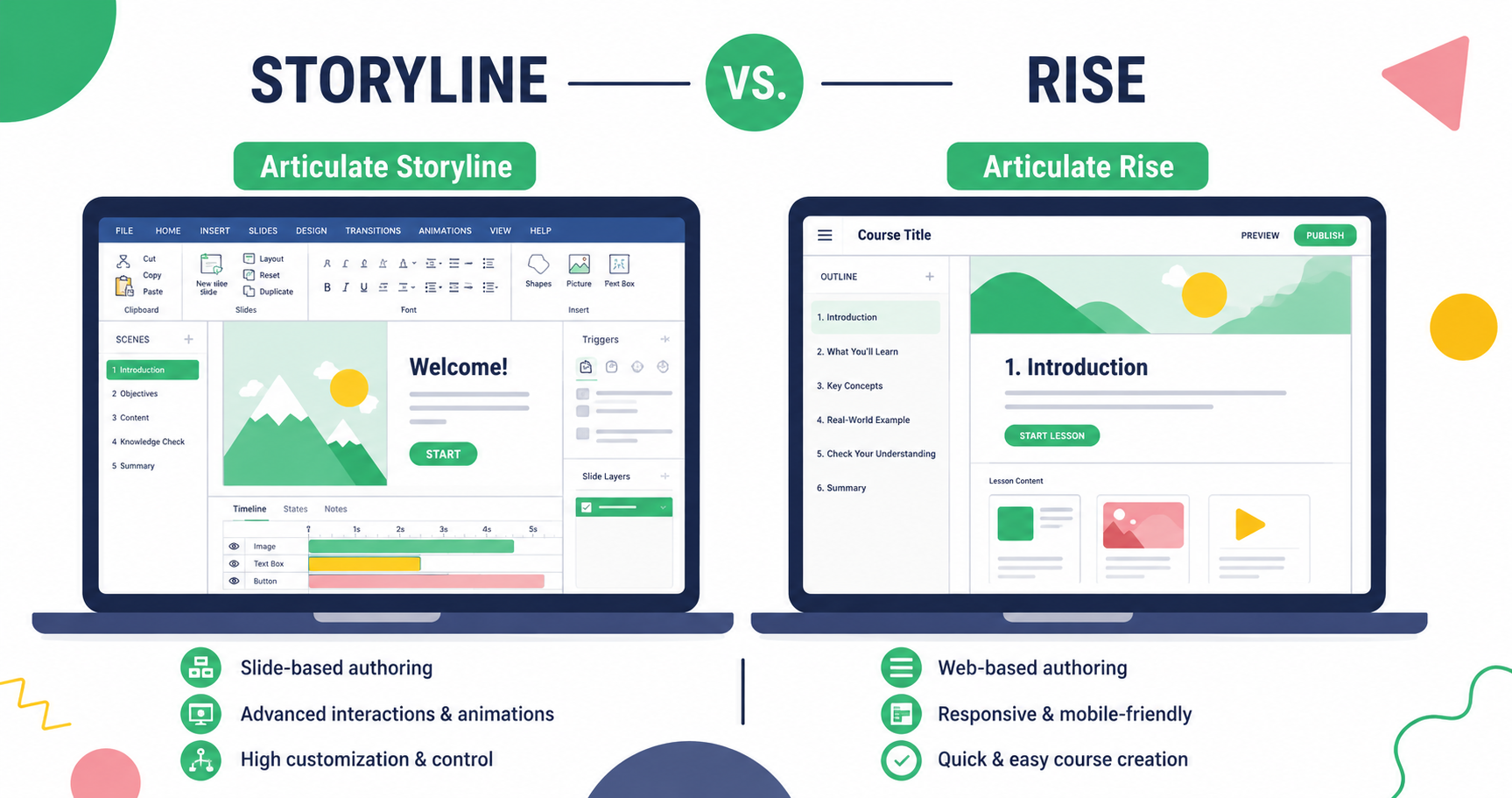 Articulate Storyline (left) and Articulate Rise (right) are the two most in-demand authoring tools in corporate L&D.
What does the eLearning development process look like, start to finish?
Real projects do not follow a perfect linear path, but most eLearning development work moves through a recognizable sequence. Understanding this sequence is what separates someone who knows a tool from someone who can actually run a project.
1. Kickoff and needs analysis
You meet with a stakeholder or client to understand the business problem. What is the performance gap? Who is the audience? What do they need to be able to do differently after completing this training? This phase determines whether eLearning is even the right solution.
2. Learning objectives
You write specific, measurable objectives that describe what learners will be able to do after the course. These objectives drive every other decision: what content to include, what to leave out, and how to assess understanding.
3. Storyboard
You map the course screen by screen in a document, usually a Word template or Google Slides. Each slide shows the visual layout, on-screen text, narration script, interactions, and any branching logic. Stakeholders review and approve the storyboard before you build anything.
4. Alpha build
You build the first version of the course in your authoring tool. This is a functional prototype: not polished, but navigable. You share it with reviewers for feedback on structure and flow.
5. Beta build and review cycles
You incorporate feedback, add final media (recorded audio, polished graphics, video), and share again. Most projects go through two to three review cycles. Each round gets more granular: content accuracy first, then visual polish, then technical QA.
6. Publish and deploy
You export the course as a SCORM 1.2, SCORM 2004, or xAPI package and upload it to the organization's LMS. You test tracking, completion logic, and assessment scoring before announcing it to learners.
"The build is not the hard part. The storyboard is the hard part. If you get the storyboard right, the build is just execution." — Dr. Robin Sargent
What skills do you need to get hired as an eLearning developer?
Job postings for eLearning developers and instructional designers consistently cluster around the same skill set. Here is what employers actually look for, based on what shows up in corporate, healthcare, government, and tech sector job listings.
| Skill | Why Employers Want It | How to Demonstrate It |
|---|---|---|
| Articulate Storyline 360 | Listed in ~70% of ID job postings | Portfolio samples in Storyline |
| Storyboarding | Shows you can plan before you build | Include storyboard samples in portfolio |
| Writing and editing | Poor writing makes bad courses | Sample scripts, on-screen copy in your work |
| LMS administration basics | You need to get the course into the system | Mention platforms you have used (Cornerstone, Docebo, Canvas) |
| SME collaboration | You will never be the subject matter expert | Describe process in resume and interviews |
| Video and screen recording | Video is increasingly central to L&D | Include a Camtasia or screen-rec sample |
| AI tools for content development | Emerging requirement, growing fast | AI badge or certification on your resume |
According to the U.S. Bureau of Labor Statistics, employment of training and development specialists is projected to grow 6 percent through 2033, faster than the average for all occupations. Demand for people who can design and build digital learning is a significant driver of that growth.
How do you break into eLearning development as a career changer?
Most people who move into eLearning development are not coming from a technology background. They are teachers, corporate trainers, HR professionals, or people in adjacent roles who realize their existing skills in communication, curriculum, and facilitation translate directly into this field.
The path that actually works has three components working together:
- A structured learning program that covers both the theory (instructional design) and the practice (authoring tools, storyboarding, project workflow). Self-study alone tends to leave gaps.
- A portfolio of real work. Not certificate screenshots. Actual course samples that a hiring manager can click through. This is what gets you interviews.
- Real project experience before you apply. An internship or practicum, even a short one, closes the gap between training and employment. It also gives you a project you can describe in interviews with specific outcomes.
IDOL Academy builds all three into one program. The 24-week curriculum covers instructional design frameworks, authoring tools, storyboarding, video production, and AI-assisted development. You build a portfolio as you go, earning 16 Credly-verified badges across 8 milestone completions. And the program includes 4 internship pathways, most of which are designed to be completable without leaving your current job.
The credential you earn at completion is the CPTP (Certified Professional in Training and Performance), authorized by the Georgia Nonpublic Postsecondary Education Commission (GNPEC). It is a recognized credential, not a self-issued certificate of completion.
You can read more about the full credential structure in the IDOL Academy Knowledge Base, including how the 16 badges break down and what the internship pathways actually look like.
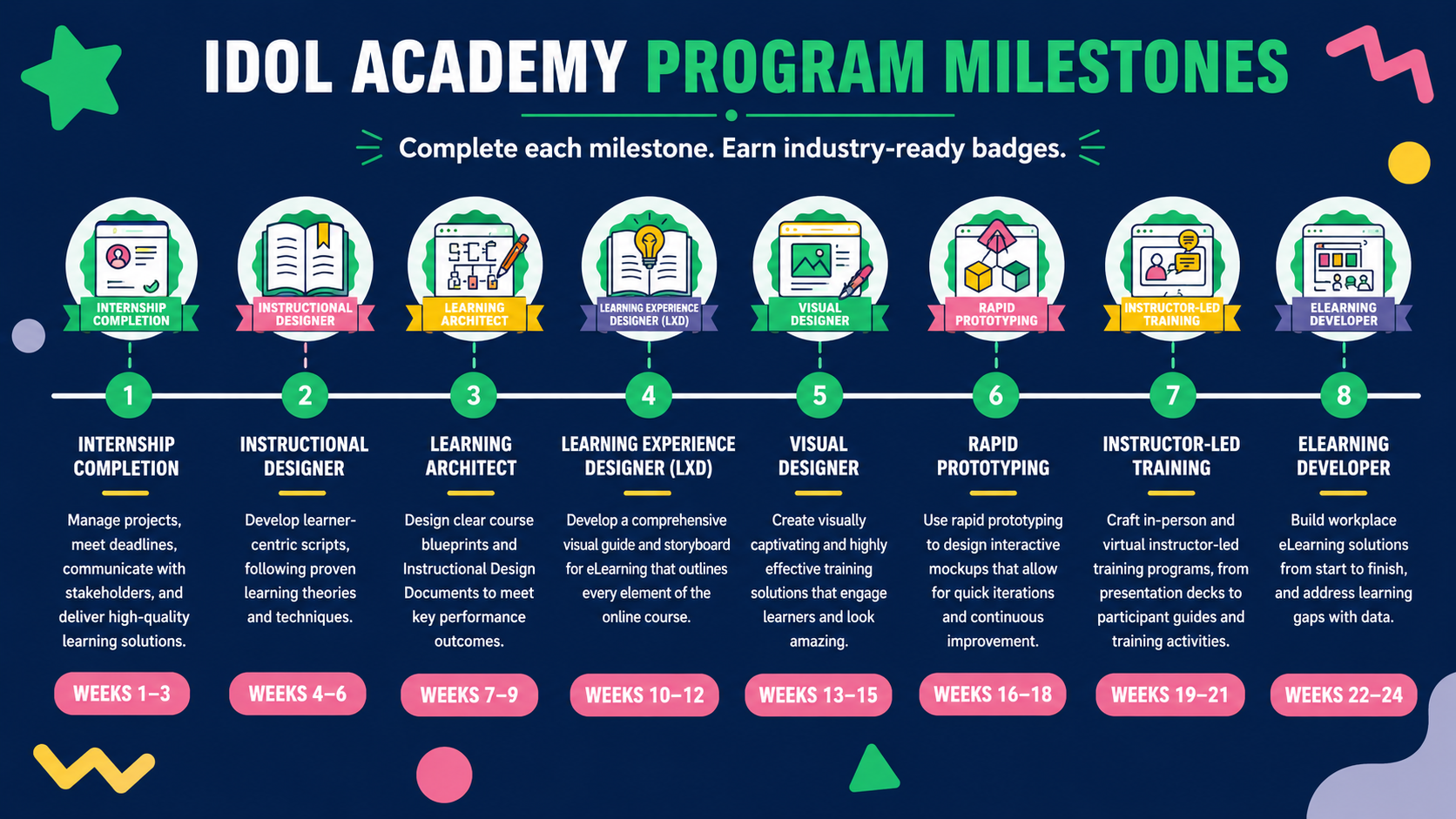 IDOL Academy's 8-milestone structure gives you checkpoint credentials throughout the 24-week program, not just at the end.
Frequently Asked Questions
What is eLearning development?
eLearning development is the process of designing and building digital learning experiences. It includes writing scripts and storyboards, building interactions in authoring tools like Articulate Storyline or Rise, and publishing finished courses to a learning management system. It is a core skill set for instructional designers working in corporate L&D.
What is the difference between instructional design and eLearning development?
Instructional design is the broader discipline of analyzing a learning problem and designing a solution. eLearning development is one specific output of that process, where the solution takes the form of a digital course. Many instructional designers do both: they design the learning strategy and then build the eLearning themselves.
What tools do eLearning developers use?
The most widely used authoring tools are Articulate Storyline 360 and Articulate Rise. Other common tools include Adobe Captivate, iSpring, and Lectora. Video and screen recording tools like Camtasia and Vyond are also common. Most job postings list Storyline as a required or preferred skill.
Do you need a degree to become an eLearning developer?
No. Many working eLearning developers and instructional designers entered the field through certificate programs, portfolio-based learning, or career transitions from teaching and training. What employers consistently evaluate is your portfolio: they want to see real course samples that demonstrate your ability to build effective digital learning.
How long does it take to learn eLearning development?
You can learn the fundamentals of eLearning development in a structured program in about 24 weeks. That timeline is enough to become proficient in one or two authoring tools, build a portfolio of real course samples, and understand the instructional design process behind them. Independent self-study with no structure or feedback typically takes longer.
How much do eLearning developers earn?
According to the U.S. Bureau of Labor Statistics, the median annual wage for training and development specialists was $63,080 as of May 2023, with the top 10 percent earning more than $100,000. eLearning developers with strong portfolios and tool proficiency often command salaries toward the higher end of that range, particularly in tech and healthcare sectors.
eLearning development is a real, in-demand skill set that sits at the center of the instructional design profession. If you want to move into this field, start with a structured program that gets you building real work from day one.
Want to see if instructional design is the right move for you?
IDOL Academy is a GNPEC-authorized 24-week program that combines 16 Credly-verified credentials, built-in AI training, and a real internship milestone, all at a price point below comparable bootcamps.
Try IDOL Academy Free```