What Is a Learning Experience Designer (LXD)?
Jun 26, 2026
What Is a Learning Experience Designer (LXD)?
By Dr. Robin Sargent · Founder, IDOL Academy ·9 min read
Quick answer
A learning experience designer (LXD) designs training and education with the learner's full experience as the priority. The role blends instructional design theory with UX thinking, visual design, and performance measurement. Most LXDs work in corporate L&D, and the title often appears alongside or in place of "instructional designer" in job postings.
In this article
A learning experience designer (LXD) is someone who builds training with the learner at the center of every decision. Not just the content, not just the objectives, but the entire journey a person takes from not knowing something to actually being able to do it. The title is relatively new, but the work is deeply familiar to anyone who has spent time in instructional design, UX, or education. If you are considering a career in this space, understanding what the role actually involves will help you figure out whether it is the right move and what you need to get there.
LXD vs. instructional design: what's actually different?
This is the question I get most often, and the honest answer is: less than people think. Both roles design learning. Both use adult learning theory. Both care about measurable outcomes. The difference is more about emphasis and framing than a hard line in the sand.
Instructional design has its roots in the military and academia. It is systematic, structured, and heavily focused on learning objectives and performance outcomes. The ADDIE model (Analyze, Design, Develop, Implement, Evaluate) is the classic framework, and most ID work still follows some version of it.
LXD borrows all of that and adds a UX lens. It asks: how does the learner feel moving through this? Where do they get frustrated? Where do they disengage? It treats the learner like a user and the course like a product, not just a content delivery vehicle. That shift in perspective changes how you approach everything from navigation to feedback to pacing.
| Dimension | Instructional Designer | Learning Experience Designer |
|---|---|---|
| Primary framework | ADDIE, SAM, Bloom's Taxonomy | ADDIE/SAM + UX design thinking |
| Core focus | Learning objectives, content structure, performance outcomes | End-to-end learner journey, usability, engagement |
| Visual design | Functional, content-driven | Integral to the experience |
| Learner lens | Learner as audience | Learner as user |
| Typical job titles | Instructional Designer, Curriculum Developer | LXD, Learning Designer, Senior Instructional Designer |
| Where they work | Corporate L&D, higher ed, government | Corporate L&D, ed-tech, product companies |
In practice, most job postings use these titles interchangeably. You will see "Learning Experience Designer" at a company like Google and "Instructional Designer" at a company doing nearly identical work. The skills the employer wants are usually the same. What changes is the culture and the design philosophy baked into the team.
What does a learning experience designer actually do every day?
This varies by organization size, but here is what a typical week looks like for an LXD in a mid-to-large corporate L&D team:
- Needs analysis: Meeting with a subject matter expert or business stakeholder to define what problem the training actually needs to solve. (Hint: it is rarely what they originally ask for.)
- Storyboarding: Sketching or wireframing the course structure before building anything. This is where learning objectives get mapped to content, interactions, and assessments.
- Prototyping and development: Building in tools like Articulate Storyline, Articulate Rise, Adobe Captivate, or Lectora. Some LXDs also use Canva, Figma, or custom HTML depending on the organization.
- Learner testing and iteration: Running the course with a small group before full rollout, gathering feedback, and revising based on where people got confused or dropped off.
- LMS administration: Publishing the final course to a learning management system (Workday Learning, Cornerstone, Docebo, Moodle, etc.) and troubleshooting any technical issues.
- Data review: Pulling completion rates, assessment scores, and learner feedback to evaluate whether the training actually worked.
In smaller companies or as a freelancer, you do all of this yourself. In larger organizations, some of these tasks are split across a team: an LXD handles design and development while a separate team manages the LMS. Either way, the core competency is the same: translating a performance problem into a learning solution that actually gets used.
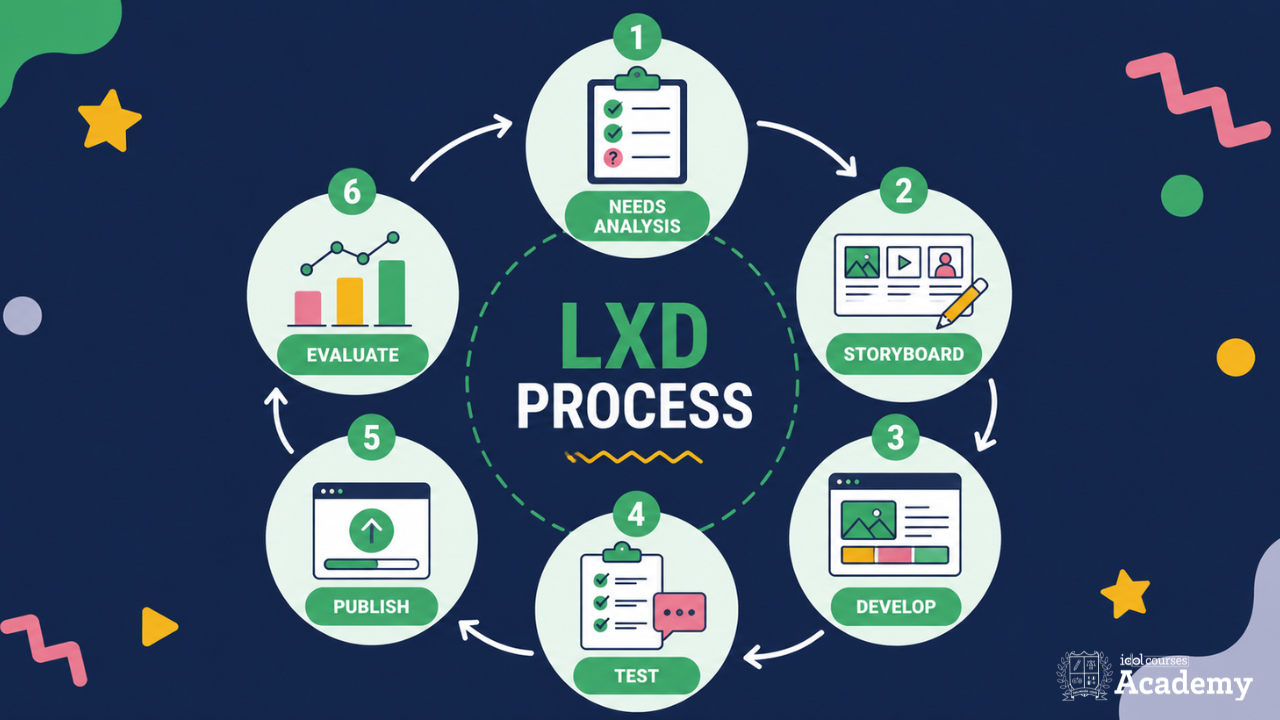 The LXD workflow: from stakeholder conversation to measurable outcome.
Want the full program details before you decide?
IDOL Academy is a GNPEC-authorized 24-week program that combines 16 Credly-verified credentials, built-in AI training, and a real internship milestone, all at a price point below comparable bootcamps.
Download the BrochureWhat skills do you need to get hired as an LXD?
Job postings for learning experience designers tend to cluster around the same core skill set, regardless of industry. Here is what shows up most often and what actually matters on the job:
Foundational knowledge
- Adult learning theory (andragogy, Knowles, Bloom's Taxonomy)
- Instructional design models (ADDIE, SAM, backward design)
- Learning objectives writing (action verbs, measurable outcomes)
- Needs analysis and gap analysis methods
Technical tools
- Articulate Storyline and/or Articulate Rise (the most requested tools in job postings by a wide margin)
- Adobe Captivate or Lectora (less common, but still appearing in enterprise job descriptions)
- Canva or Adobe Creative Suite for visual design assets
- At least one LMS (Workday Learning, Cornerstone, Moodle, Docebo)
- Video tools: Camtasia, Vyond, or similar for screen recording and animation
Emerging skills employers are now asking for
- AI-assisted content creation: using tools like ChatGPT, Claude, or specialized ID tools to accelerate storyboarding and content drafts
- Accessibility: WCAG 2.1 standards and how they apply to e-learning
- Data literacy: reading LMS analytics and translating them into design decisions
The portfolio matters more than almost anything else. You can list every tool in the world on a resume, but hiring managers want to see what you built. A portfolio with three to five strong samples, each showing your design thinking, not just a finished product, will open more doors than a credential alone. That said, credentials verify your knowledge to someone who cannot yet see your work, which is exactly why verifiable badges and a recognized certificate matter at the entry level.
"The portfolio is your proof. The credential is your permission slip to get in the room." — Dr. Robin Sargent
What does a learning experience designer earn?
Salaries vary by title, industry, location, and experience level. Here is the honest breakdown, using data from the U.S. Bureau of Labor Statistics.
| Role / Level | Median Annual Salary | Notes |
|---|---|---|
| Training & Development Specialist | $63,080 | BLS SOC 13-1151, 2023 data |
| Instructional Designer / Technologist | $74,570 | BLS SOC 25-9031, 2023 data |
| Learning Experience Designer (entry) | $55,000–$70,000 | Typical range in non-tech corporate roles |
| Learning Experience Designer (mid) | $75,000–$95,000 | 3–6 years experience, strong portfolio |
| Senior LXD / L&D Manager (tech sector) | $100,000–$140,000+ | Large tech companies, major metros |
Location and industry matter significantly. An LXD at a healthcare system in the Midwest will earn differently than one at a tech company in Seattle. Freelance and contract LXDs can charge $50–$150 per hour depending on specialization and the client's budget. The career path has real earning potential, especially once you move past the entry-level range and have a body of work to show for it.
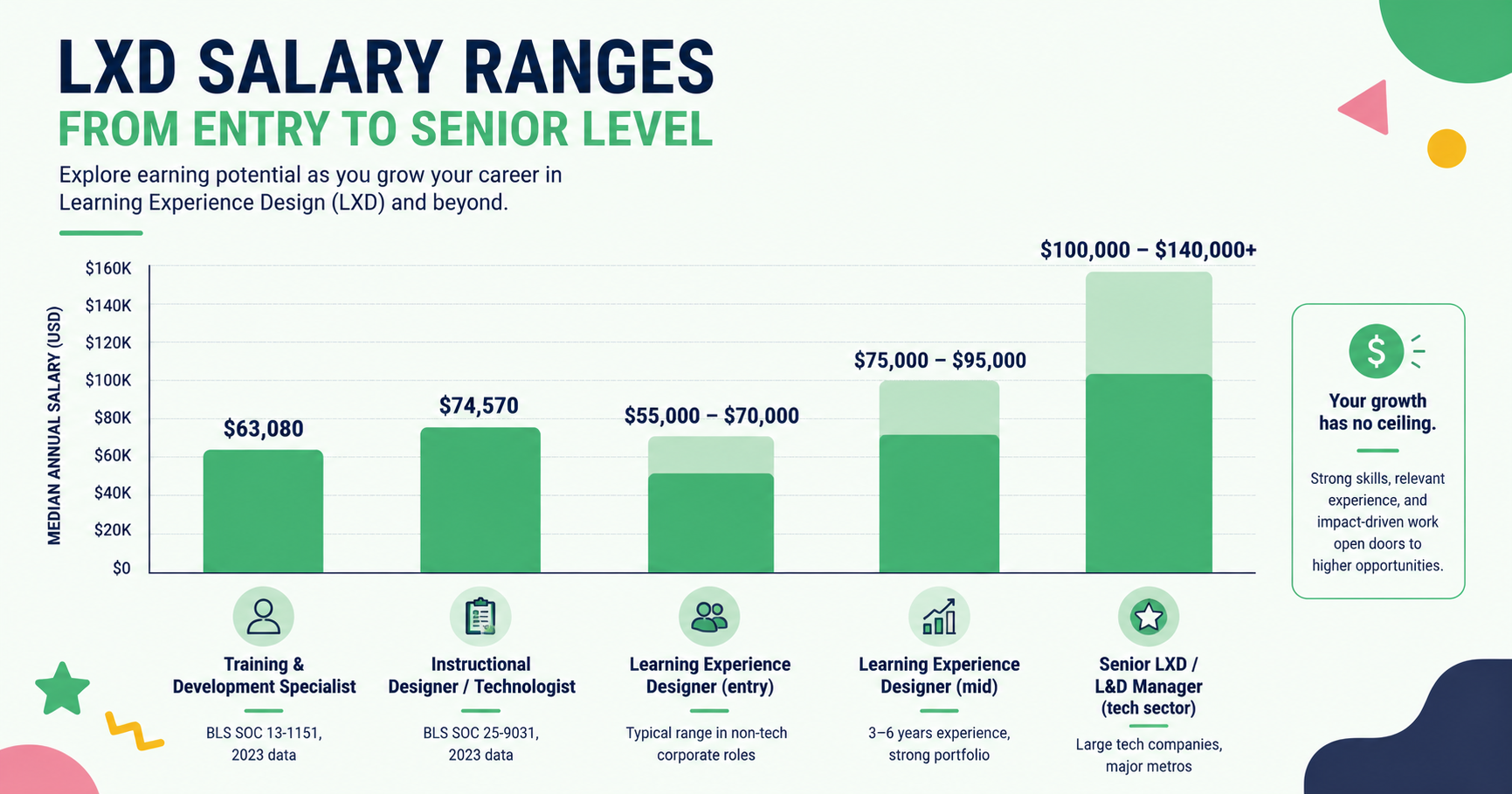 LXD salary ranges by experience level. Data: U.S. Bureau of Labor Statistics, 2023.
How do you break into LXD without starting from scratch?
This is where it gets practical. Most people who move into LXD come from somewhere adjacent: teaching, corporate training, HR, marketing, healthcare education, or technical writing. The good news is that the transferable skills are real and substantial. The gap is usually on the technical and portfolio side, not the foundational knowledge side.
Here is what that transition typically looks like in three stages:
Stage 1: Build the knowledge base
If you are coming from K-12 teaching, you already understand learning objectives, differentiation, and formative assessment. If you are coming from corporate training, you know how adults learn in a workplace context. You need to layer on the ID-specific frameworks (ADDIE, SAM, backward design) and the vocabulary employers use, because the language of L&D is different from the language of classroom education.
Stage 2: Learn the tools
Articulate Storyline is the most in-demand tool in the industry. Rise is close behind. You do not need to master every tool before you apply for your first role, but you need to be able to show one or two samples built in the tools employers actually use. Tool proficiency without a sample to show for it does not get you far in interviews.
Stage 3: Build a portfolio and get a credential
This is where most self-taught career changers stall. They learn the theory, they dabble in the tools, and then they try to break in with a resume and no portfolio. It does not work. You need real samples, ideally created in a structured environment where you get feedback and iterate, not just a demo course you built alone following a YouTube tutorial.
IDOL Academy is built specifically for this stage. The 24-week program is structured around 8 milestones, each of which produces a portfolio artifact and earns a Credly-verified badge. By the time you complete the program, you have 16 verifiable credentials and a portfolio built with real tools on real-world style projects. The program also includes an internship milestone, which gives you supervised experience you can talk about in interviews. It is authorized by the Georgia Nonpublic Postsecondary Education Commission (GNPEC), and graduates earn the CPTP (Certified Professional in Training and Performance) credential.
You can read more about how this path works in the IDOL Academy Knowledge Base or explore How to Build an Instructional Design Portfolio for a deeper look at what your samples need to include.
Frequently Asked Questions
What is a learning experience designer (LXD)?
A learning experience designer (LXD) is a professional who designs training and educational content with the learner's full experience as the primary consideration. The role blends instructional design theory, UX principles, and visual communication to create learning that is engaging, accessible, and measurable.
Is LXD the same as instructional design?
They overlap significantly, but LXD places a stronger emphasis on empathy, usability, and the end-to-end learner journey, borrowing more explicitly from UX design. Instructional design tends to focus on learning objectives, content structure, and performance outcomes. In practice, many job postings use the titles interchangeably.
What skills do you need to become a learning experience designer?
Core skills include adult learning theory, needs analysis, storyboarding, e-learning development tools (like Articulate Storyline or Rise), visual design basics, and data interpretation. Increasingly, employers also expect familiarity with AI-assisted content creation and accessibility standards like WCAG 2.1.
How much does a learning experience designer earn?
According to the U.S. Bureau of Labor Statistics, training and development specialists earn a median annual wage of $63,080, while instructional designers and technologists earn a median of $74,570. Learning experience designers in corporate settings, especially at large tech companies, often earn above that range depending on location and experience.
Do you need a degree to become a learning experience designer?
A traditional degree is not required. Many employers prioritize a strong portfolio and verifiable credentials over a specific degree. Vocational certificate programs, like IDOL Academy, are designed specifically to help career changers build that portfolio and earn credentials recognized by the industry.
What is the difference between an LXD and an eLearning developer?
An eLearning developer typically focuses on the technical build: coding interactions, publishing SCORM packages, and troubleshooting an LMS. A learning experience designer works earlier in the process, defining the strategy, learning objectives, and overall experience before development begins. Many LXDs also develop their own content, especially in smaller organizations.
Learning experience design is a real, in-demand career with a clear skill set, a defined hiring market, and a path in that does not require a graduate degree. If you want to see exactly how the IDOL Academy program maps to that path, the brochure lays it all out.
Want the full program details before you decide?
IDOL Academy is a GNPEC-authorized 24-week program that combines 16 Credly-verified credentials, built-in AI training, and a real internship milestone, all at a price point below comparable bootcamps.
Download the Brochure